Apple Juice Pilot Trials: Setting Pectinase Concentration by Yield, Clarity and Cost-in-Use
How juice plants run a pectinase concentration trial on apple mash: trial design, bench protocol, reading results, troubleshooting and scale-up, then request a trial sample and quote.
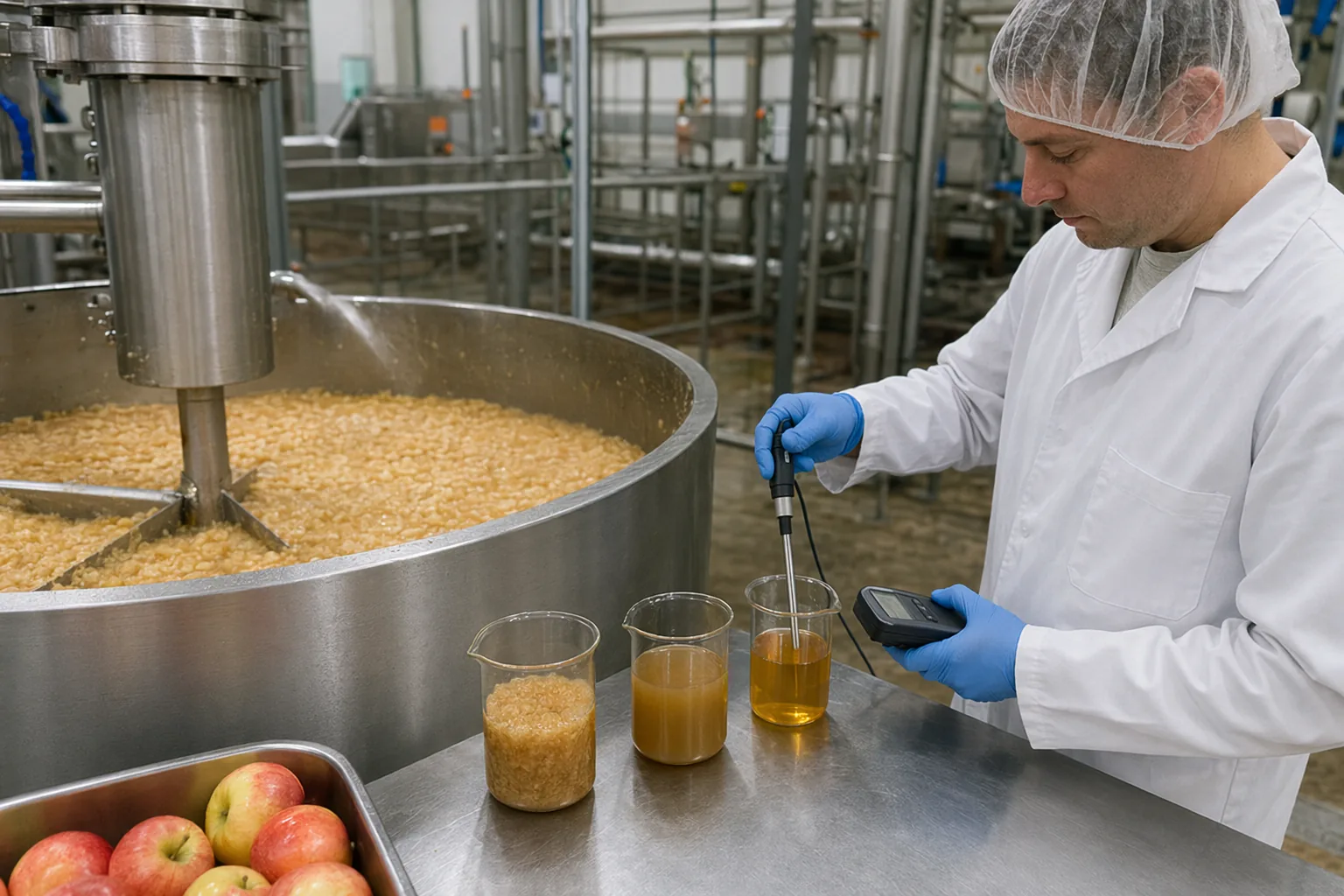
Too little enzyme leaves pectin in the mash; too much adds cost without extra juice. A concentration trial on your own apples finds the dose where yield, press time, clarity and enzyme cost balance.
This guide is for juice plants, cider-base producers and contract processors that are qualifying a pectinase concentrate or changing supplier, and for the distributors who support those trials.
To request a trial sample or a quote, send the product (liquid or powder, activity grade), quantity, pack size and destination.
Why the Dose Has an Economic Optimum
Apple mash contains pectin that increases viscosity, binds juice within the pulp structure and slows clarification. A pectinase system hydrolyzes that pectin and improves free-run juice release. However, more enzyme is not always better. Once the pectin is sufficiently degraded, extra dose delivers little additional yield and raises cost-in-use. Over-processing can also affect mouthfeel or create clarification behavior that does not match the product target.
The objective is a repeatable decision that links the enzyme step to measurable production results, documented quality controls and a qualified supply chain.
Primary goal: improve juice release and pressability. • Secondary goal: reduce viscosity and support clarification. • Commercial decision: optimize cost per ton of apples processed.
Trial Design
Use one apple variety and maturity, one milling setting, equal mash weights and the same pressing method for every treatment. Run a no-enzyme control and at least three dose levels, chosen from the activity stated on the product documents. Keep pH and temperature constant within the product's working range of pH 3.0–5.0 and 40°C–55°C, and hold the same contact time for every treatment.
Record yield, press cake moisture, viscosity, turbidity, soluble solids, color and any downstream filtration impact. Controlled comparisons give usable results; one-off observations do not.
Include a no-enzyme control. • Use activity-based dosing when possible. • Keep mash preparation and press conditions identical. • Confirm trial conditions against the product documents.
Bench Protocol
A simple bench protocol can provide reliable pectinase apple juice experiment results when sampling and timing are tightly controlled. Prepare a uniform apple mash using the same grinder setting, then divide it into equal test portions by weight. Warm each portion to the target temperature, check pH, and add the diluted Pectinase Concentrate while mixing thoroughly. Hold samples in closed vessels to limit evaporation and oxidation, agitating gently at set intervals. After the reaction time, press each sample using the same pressure, press duration, and cloth or filter setup. Collect free-run and pressed juice separately if that reflects the factory process. Measure recovered juice weight, calculate yield as a percentage of mash weight, and note press cake appearance. To reduce random error, run duplicate or triplicate samples, especially when comparing close dosage levels or evaluating a new polygalacturonase-rich formulation.
Weigh mash, enzyme solution, juice, and press cake accurately. • Use identical pressing conditions for every treatment. • Prepare enzyme dilutions immediately before use. • Run replicates to confirm repeatability.
Reading the Results
Good results are not defined by yield alone. Calculate the incremental juice gain against the control, then weigh it against enzyme cost, added holding time, heating energy and any filtration or clarification savings. A lower dose may be preferred if it delivers most of the yield improvement at a better cost-in-use.
Review quality data together. Turbidity needs context: treated juice can first release fine particles, while clarification may improve after settling, filtration or fining. Brix should stay consistent unless a dilution or concentration error occurred. For cloudy apple juice the target may be stable haze rather than maximum clarity; for clear juice or concentrate, lower viscosity and a negative pectin test matter more. Treat bench results as preliminary until a pilot press confirms them.
Compare incremental yield with enzyme cost. • Track viscosity, turbidity, color, Brix, and acidity. • Check whether higher dosage gives diminishing returns. • Match results to clear, cloudy, NFC, or concentrate targets.
Troubleshooting Weak Yield or Cloudy Results
If the effect of pectinase on apple juice extraction is weaker than expected, first check whether the enzyme contacted the mash uniformly. Poor mixing, cold mash zones, short retention time, or incorrect dilution can cause underperformance. Next, verify pH and temperature at the mash, not only at the tank jacket or inlet. Pectinase activity can drop outside its effective range, and high heat may inactivate the enzyme before it works. If yield improves but turbidity remains high, the issue may involve starch, protein-polyphenol complexes, fining strategy, or filtration load rather than pectin alone. If filtration improves but yield does not, the dosage may be better suited to clarification than extraction. Also review sulfite, preservatives, sanitation residues, or cleaning chemicals that may inhibit enzymes. Troubleshooting should be supported by repeat runs and a clear comparison to the untreated control.
Measure actual mash pH and mash temperature. • Check mixing and enzyme distribution. • Separate yield problems from clarification problems. • Review possible inhibitor carryover from sanitation.
From Bench to Production
Run the pilot at a scale large enough to reflect real mixing, heat transfer, residence time and press loading, with the apple varieties, milling profile, tank geometry and schedule used in production. For larger juice processors a staged program reduces risk: bench test, pilot press, extended plant trial, then a commercial purchase specification. This helps purchasing, production, QA and finance agree on the real value of the enzyme program.
Validate in pilot equipment before production adoption. • Repeat across apple varieties and seasonal raw material. • Set operating limits for pH, temperature, dose and contact time. • Write the agreed dose into the purchase specification.
Technical Buying Checklist
Trial product: liquid or powder, and activity grade (100,000 or 500,000 PGAU/g) • Trial quantity and the pack size for routine supply (1 kg, 5 kg, 25 kg or 200 L) • Documents: COA, TDS and SDS • Apple varieties, process step and the result you need (yield, clarity, filtration) • Destination
A complete package should include a Certificate of Analysis for the supplied lot, a Technical Data Sheet with activity definition and recommended operating range, and a Safety Data Sheet for handling and storage. For B2B procurement, supplier qualification should also include sample availability, pilot validation support, change notification expectations, and cost-in-use modeling.
Request a Trial Sample and Quote
Juice plants, contract processors and distributors can request a trial sample and a quote by email or through the inquiry form. Send the product (liquid or powder, activity grade), quantity, pack size and destination, plus the apples and process step you will test. Pricing is quoted per order. Free sample included with every qualified inquiry.
Pectinase (Concentrate) for Research & Industry
Need Pectinase (Concentrate) for your lab or production process?
ISO 9001 certified · Food-grade & research-grade · Ships to 80+ countries
Frequently Asked Questions
What is a good starting pectinase concentration for an apple juice experiment?
There is no universal starting level: it depends on enzyme activity, apple variety, pH, temperature, and contact time. Set trial levels from the activity-based dosage guidance on the product documents. Run at least three dosage levels plus a no-enzyme control, then compare yield, viscosity, turbidity, and cost-in-use.
Why did my pectinase apple juice experiment show little yield improvement?
Common causes include poor enzyme distribution, insufficient contact time, low mash temperature, pH outside the enzyme’s effective range, or apples with lower pectin-related extraction limitation. Also check whether sanitation residues, preservatives, or excessive heat reduced enzyme activity. Repeat the trial with verified mash pH and temperature, consistent milling, and a no-enzyme control to confirm whether the issue is enzyme performance or process variation.
What pH and temperature are suitable for pectinase in apple juice?
Apple mash is naturally acidic. Our concentrate works at pH 3.0–5.0 and 40°C–55°C. Measure pH and temperature directly in the mash, not only in the tank system, and keep them constant across all trial treatments.
How should industrial buyers compare different pectinase suppliers?
Compare suppliers by validated performance and total cost-in-use, not only price per kilogram. Request COA, TDS, SDS, activity definition, shelf life, storage conditions, and lot traceability. Run side-by-side pilot trials using identical apples and process conditions. Evaluate yield gain, viscosity reduction, filterability, turbidity, dosage required, lead time, packaging fit, technical support, and the supplier’s ability to support change control.
Does more pectinase always produce better apple juice extraction results?
No. Once available pectin is sufficiently degraded under your process conditions, additional pectinase may provide minimal yield improvement while increasing enzyme cost. Higher dosage may also alter clarification behavior or processing time targets. The best concentration of pectinase on apple experiment results is usually the lowest robust dosage that meets yield, viscosity, turbidity, and filtration requirements with acceptable cost-in-use.
Plan Your Apple Juice Dose Trial
Request Pectinase Concentrate samples, COA/TDS/SDS, and pilot dosage support for your apple juice extraction process.
Contact Us to Contributehello@mail.topenzyme.com